
How AI Decides Which Hotels to Recommend:
Six Signals Every Hotel Owner and Marketing Leader Should Understand


For decades, hotel discovery was shaped by search engines. If your property ranked well on Google and had strong OTA visibility, you were in the game. But the rise of AI-powered discovery—through platforms like ChatGPT, Google’s AI Overviews, Perplexity, and other answer engines—is changing how travelers decide where to stay.
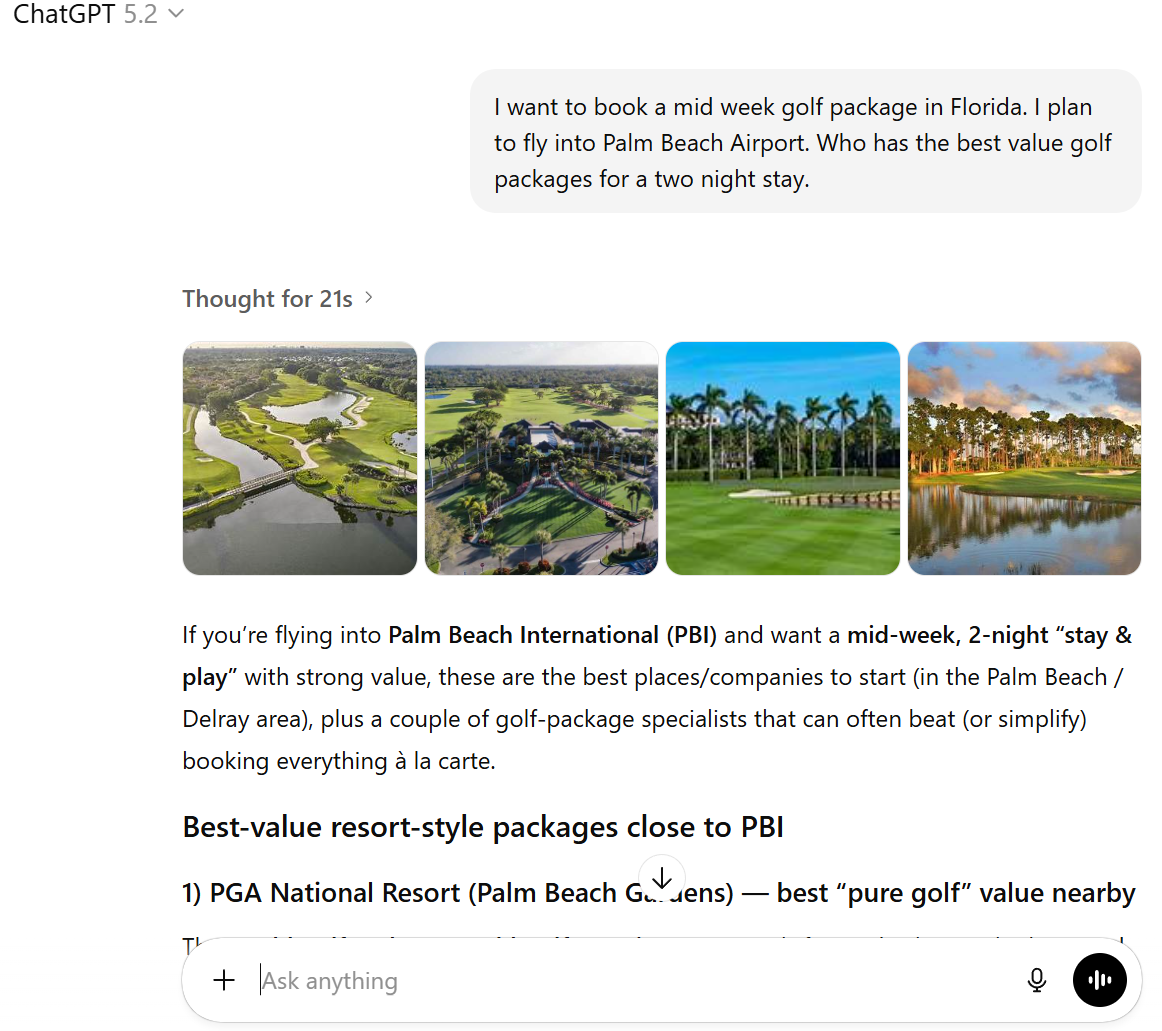
Instead of presenting a list of links, AI systems provide direct recommendations. A traveler might now ask:
“What are the best luxury resorts in Aspen with a spa?”
The AI doesn’t simply show ten websites. It selects a handful of properties it believes best answer the question.
For hotel owners and marketing leaders, the key question becomes:
How does AI decide which hotels to recommend?
Through observation of how AI engines assemble travel answers, six major signals consistently influence whether a property appears—or disappears—in AI-driven discovery.
Over 40% of travel searches start on an AI platform
1. Topical Authority Around Experiences
AI models associate hotels with specific travel experiences. Properties that repeatedly appear in content about particular themes become strongly linked to those categories.
Examples include:
- wellness retreats
- ski-in/ski-out resorts
- beachfront honeymoon destinations
- culinary-focused hotels
- family-friendly resorts
If your hotel is mentioned frequently in content related to luxury wellness, the AI learns to associate your property with that experience.
This means that when someone asks:
“What are the best wellness resorts in Arizona?”
AI systems are more likely to recommend properties that have strong topical authority in wellness-related content, not simply those with the most prominent brand pages.
For hotels, this means marketing must extend beyond property descriptions and actively shape how the web talks about your experiences.
2. Multi-Source Citation Consistency
AI models trust information that appears consistently across multiple credible sources.
These sources might include:
- travel publications
- destination guides
- tourism boards
- business listings
- editorial blogs
- property websites
When the same property is described similarly across several trusted sources, AI systems gain confidence in recommending it.
Think of it as digital cross-verification.
If your property appears only on your brand website but nowhere else, the AI has limited confirmation of your relevance. But if multiple independent sources reference your hotel as, for example, a leading spa resort or wedding destination, the AI is more likely to include you in answers.
For marketing teams, this highlights the importance of distributed brand presence, not just website optimization.
3. Structured Knowledge Signals
AI engines rely heavily on structured information to understand hotel attributes.
These signals include clearly defined details such as:
- spa services
- dining venues
- event spaces
- pools and recreation
- beach access
- ski access
- family amenities
The more structured and clearly defined these attributes are across the web, the easier it is for AI systems to match your property with traveler queries.
For example, if a traveler asks:
“Hotels in Aspen with a heated outdoor pool and a spa.”
The AI must be able to identify those attributes in structured form. If your hotel has these amenities but they are buried in vague descriptions or inconsistent listings, the AI may simply overlook your property.
This makes structured data and consistent information distribution critical for AI visibility.
4. Experience Depth, Not Just Property Description
Many corporate hotel websites focus heavily on property descriptions—rooms, amenities, and booking details.
But AI-driven travel questions tend to be experience-based, such as:
- What is the spa experience like?
- What are weddings like at the property?
- What dining experiences are available?
- What seasonal activities do guests enjoy?
Hotels that provide deeper storytelling and experiential content across the web create richer signals for AI models.
For example, content about:
- spa rituals
- culinary experiences
- wedding celebrations
- seasonal activities
- neighborhood exploration
helps AI systems understand the full scope of what staying at the property feels like.
Properties that only describe rooms and amenities often appear less relevant in AI-generated travel answers.
5. Guest Sentiment and Reputation Signals
AI systems learn not only from official sources but also from guest sentiment across the internet.
Review platforms and public commentary play an important role in shaping how AI perceives a property.
These signals often come from:
- Google Reviews
- TripAdvisor
- travel forums
- social discussions
Over time, AI models begin to associate properties with recurring sentiment patterns such as:
- “romantic getaway”
- “great for families”
- “excellent spa”
- “exceptional service”
These associations influence which properties are recommended for different types of travelers.
For example, if reviews frequently describe a hotel as romantic, it may surface more often in responses to queries like:
“Best honeymoon resorts in Napa Valley.”
Guest sentiment becomes a powerful form of reputation intelligence for AI systems.
6. Contextual Relevance to the Traveler’s Question
The most important factor is how closely a hotel matches the intent behind the traveler’s question.
Consider the difference between these two queries:
“Best luxury resorts in Aspen”
“Best luxury resorts in Aspen for a winter honeymoon”
The second query introduces several contextual signals:
- romance
- winter travel
- luxury
- Aspen
AI systems prioritize properties that appear connected to all of those contextual elements.
Hotels that have strong visibility across content related to romantic winter stays, for example, will likely appear higher in AI responses than properties with only general brand descriptions.
This means hotels must develop a presence across specific traveler contexts, not just broad brand positioning.
The Strategic Shift for Hospitality Marketing
The shift to AI-powered discovery changes how hotels should think about digital visibility.
Traditional search strategy focused on optimizing a single website and improving rankings. But AI-driven travel discovery relies on a network of trusted signals across the web.
Instead of relying solely on a brand website, hotels must consider:
- how their property is described across multiple sources
- whether their experiences are clearly defined
- whether their attributes are structured and accessible
- how guest sentiment shapes perception
- whether their brand appears in the contexts travelers ask about
In short, AI visibility is no longer just about search rankings. It is about how the entire internet describes and verifies your property.
For hotel owners and marketing leaders, understanding these six signals is the first step toward ensuring their properties remain visible—and recommended—in the next generation of travel discovery.