
Why AI Favors Hotel Brands That Lead
AI Is Changing Hotel Discovery
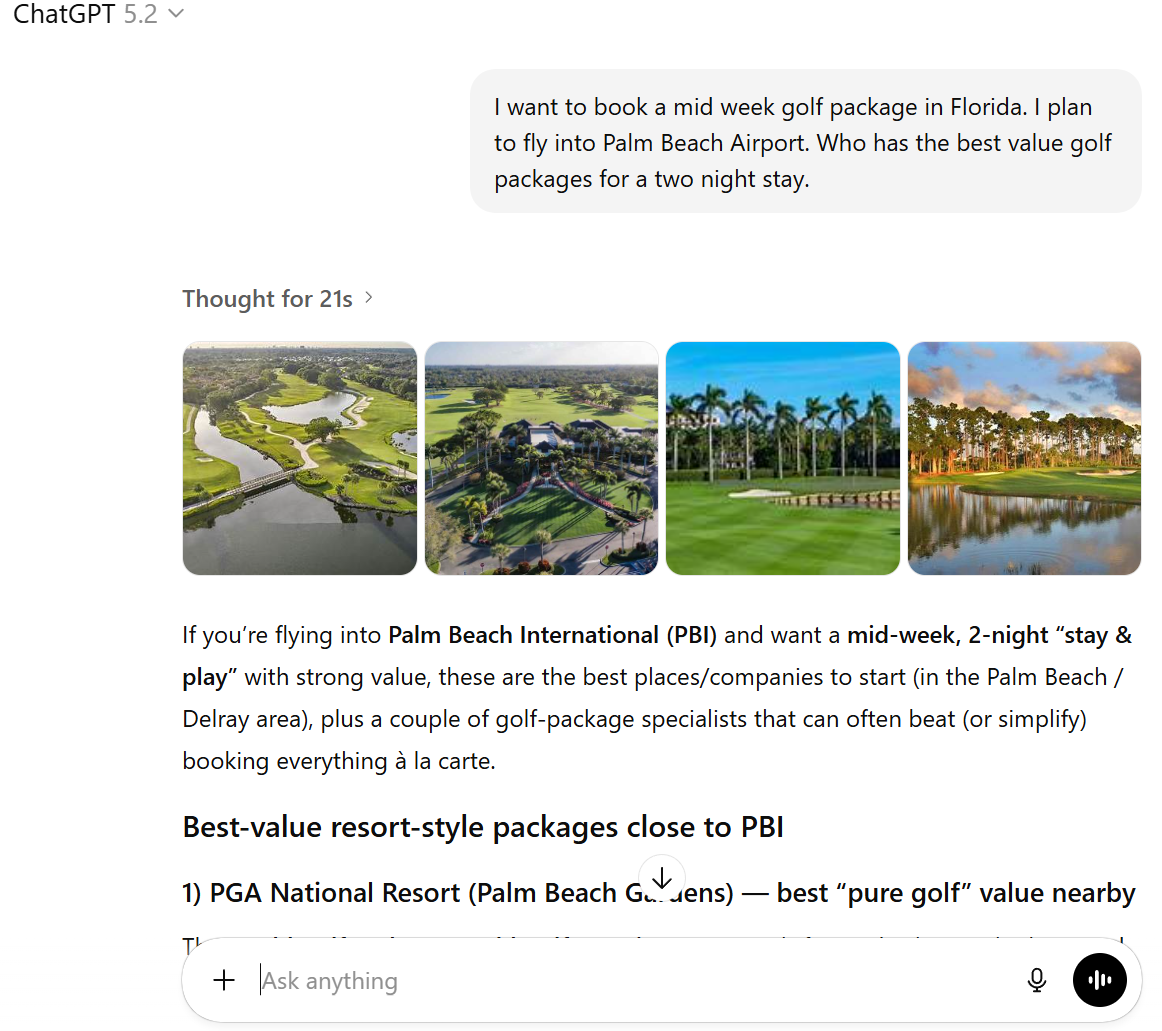
The 2026 traveler begins planning their next trip. They don’t start on Expedia. They don’t open Booking.com. They open an AI tool like ChatGPT and ask a detailed question:
“What are the best luxury resorts for a relaxing long weekend within a one-hour drive of Chicago?”
“Which hotels offer the most memorable wellness experiences near Seattle?”
“Help me find a golf resort that offers couples packages and multiple courses?”
This moment—before rates, availability, or price comparison—has quietly become the new starting point of the booking journey.
Our AI team spends a great deal of time studying how AI systems influence consumer decision-making. One technical reality is especially important for hotel brands to understand:

AI tools like ChatGPT do not browse or read live OTA listings.
They don’t scan all Expedia pages, pull real-time rates, or compare inventory grids.
Instead, AI relies on:
- Public, indexable content
- Brand-authored information
- Clearly structured, experience-led storytelling
And that changes where influence truly lives.
OTAs Focus on Transactions. Hotels Shape Preference.
Online travel agencies are built for facilitating bookings. Their content, by design, is standardized and optimized for comparison. But it is not designed to tell a rich story.
Hotel websites are different. They are where:
- Brand voice lives
- Experiences are described in depth
- Emotional connection is built
- Differentiation becomes clear
When AI is asked to recommend, explain, or summarize hotels, it leans heavily on this brand-owned content—not OTA listings. The clearer and more intentional the story, the more accurately AI can represent it.
Why This Matters Now
AI is increasingly influencing the top of the funnel—long before a traveler decides where or how to book.
A rapidly growing number of travelers now use AI to:
- Explore destinations
- Compare experiences
- Understand what makes one hotel different from another
- Decide where they want to stay before deciding how to book
Hotels that clearly articulate their value, personality, and experiences are far more likely to be surfaced, summarized, and trusted by AI systems. And when AI directs travelers to learn more, it points them to the source: the hotel’s own website.
Even With OTAs Inside ChatGPT, This Advantage Holds
You may have seen recent news about Expedia and Booking.com integrations within AI tools. These integrations allow users to check availability and complete transactions—but only when a traveler deliberately chooses an OTA app and is already in a booking mindset.
They do not influence inspiration, destination research, or experience-led discovery.
That early decision—which hotel feels right—is still shaped by brand content. And that is where hotels maintain a clear advantage.
What This Means for Hotel Brands
AI is not rewarding whoever discounts the most. It is rewarding whoever communicates most clearly.
For hotels, this creates a renewed opportunity to:
- Reduce dependency on OTAs for discovery
- Strengthen brand influence earlier in the journey
- Drive more confident, higher-intent direct traffic
Action Items
We design hotel content and digital strategies with AI influence in mind—ensuring your brand story is not only compelling to travelers, but also clearly understood and accurately represented by AI systems.
AI is not replacing brand storytelling. It is amplifying it—for brands that get it right. AEO and GEO strategies are at the forefront of 2026 action items. There exists a window of opportunity to gain the first mover advantage.
Bottom line:
OTAs may process the transaction, but AI increasingly determines who gets considered. Hotels that clearly and confidently own their story are the ones AI will surface first—and the ones travelers will trust most.
Online travel agencies are built for facilitating bookings. Their content, by design, is standardized and optimized for comparison. But it is not designed to tell a rich story.