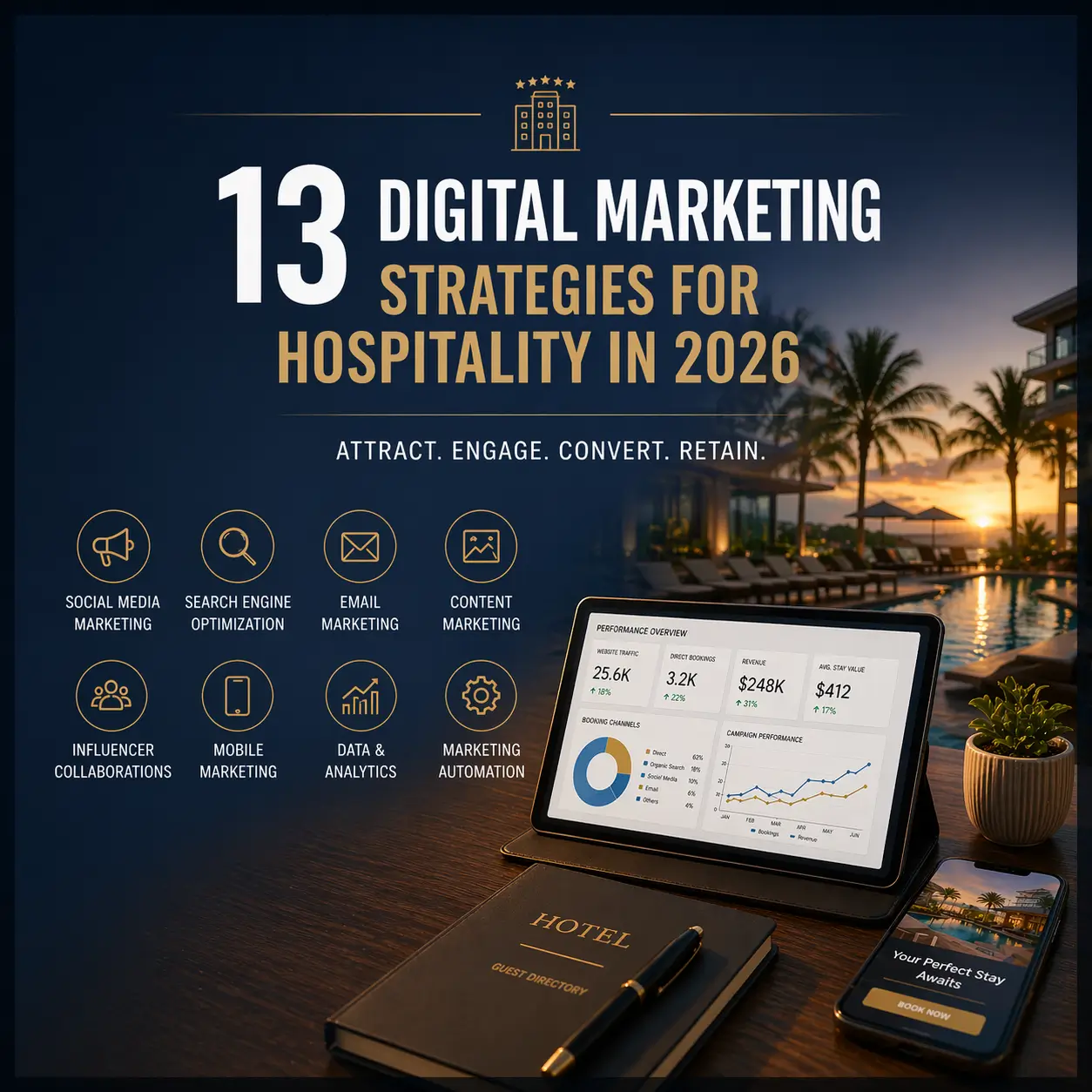
13 Marketing Strategies for Hospitality in 2026
The most effective hospitality marketing in 2026 blends first-party data, AI-driven personalization, answer engine optimization, and metasearch discipline to convert intent into booked stays. First-party data strategies drive materially higher conversion, AI lifts RevPAR (Revenue Per Available Room), and answer engines now command a meaningful share of discovery. Email remains the ROI anchor, while visual content and social proof move guests from inspiration to action. Together, these tactics form a measurable system that grows direct bookings and lifetime value.
This list distills what US hotel and resort teams need now: specific steps, credible data points, and actions that align marketing and revenue. You will learn how to:
- Collect and unify guest data
- Structure content for AI answers
- Protect price integrity on metasearch
- Use short-form video and micro-influencers for demand generation
- Build lifecycle automation that compounds revenue Where industry data is limited, we offer directional guidance and practical next steps.
Key Takeaways
- First-party data outperforms third-party data for conversions by 25-30%, and AI personalization can lift RevPAR by 3-7% Gourmet Marketing ResortTrades
- Answer engines matter: 25% of searches now occur via conversational AI, so AEO-ready content wins visibility TEGNA
- Direct booking levers: metasearch influences 15-25% of traffic, while email delivers a 36-42:1 ROI Bullseye Strategy GCommerce Solutions
1. Build Detailed Guest Personas Using First-Party and Behavioral Data
First-party data is now the backbone of direct revenue. Hotels leveraging first-party data achieve 25-30% higher conversion rates than those relying on third-party data, a shift accelerated by cookie deprecation Gourmet Marketing. Many hospitality brands also piloted AI personalization tools by 2024, signaling readiness for deeper data activation in 2026 Hooray Agency
Build personas from:
- Loyalty records
- Booking history
- Site and app behavior
- Email engagement
- Service interactions
Segment by trip intent, booking window, party size, preferred rate plans, and on-property interests. Leading brands have invested in unified guest profiles to improve personalization and cross-sell accuracy. Connect marketing and revenue teams to validate segments against ADR (Average Daily Rate) and occupancy trends.
Actions:
- Audit zero and first-party data capture across booking engine, CRM, and loyalty touchpoints.
- Standardize taxonomy for interests and intent signals, then align offers to segments.
- Connect marketing and revenue teams to validate segments against ADR and occupancy trends.
2. Personalize the Guest Journey with AI and Predictive Analytics
AI-driven personalization can raise revenue per available room by 3-7% when used to tailor pricing and offers by demand and behavior ResortTrades. Industry adoption is growing, with a significant share of hospitality brands already implementing or piloting AI tools.
Practical uses include dynamic pre-stay upsells based on past purchases, geo and weather-aware offers, and triggered emails that respond to browsing and cart abandonment rather than generic blasts. Predictive models can forecast likely spa, dining, or experience add-ons so the right offer appears at the right time.
Actions:
- Map key micro-moments: browse, search, select dates, room selection, add-ons, checkout.
- Use predictive scores to prioritize audiences for upsell and retention.
- Test content variants by segment and booking window; measure lift at each funnel step.
3. Optimize for Answer Engines and Semantic Search
Answer engines and conversational AI now drive a growing share of discovery. About 25% of searches occur via conversational AI and answer engines, so content must be answer-ready to earn visibility and clicks TEGNA.
Build pages that start with direct, one-paragraph answers to specific traveler questions, followed by concise lists and rich detail. Add an FAQ section per primary page and mark it up with schema so engines can extract precise responses. Long-form guides should group related intents, such as:
- Best time to visit
- Family amenities
- Pet policies
- Parking
- Transportation
Actions:
- Create Planning Your Stay hubs with Q&A formatting and internal links.
- Use structured data for FAQs and business details.
- Refresh content quarterly to reflect seasonal experiences and policies.
4. Leverage Metasearch and Booking Comparison Platforms
Metasearch is often the last mile before a booking decision, representing 15-25% of hotel booking traffic for many brands Bullseye Strategy. To win the click and protect direct share, maintain rate parity, current room descriptions, and consistent fees and taxes across listings.
Coordinate revenue management and marketing to align bids with demand periods, device mix, and audience intent. Keep creative aligned with your website experience to reduce post-click drop-off.
Actions:
- Monitor parity daily across key channels and correct discrepancies fast.
- Sync review scores and photo sets to metasearch to improve click-through.
- Build retargeting pools from metasearch traffic for offer-led follow up.
5. Create Experience-Led, Visually-Driven Content
Visuals sell the stay. Hotels that publish 30 or more professional photos see 25-30% higher booking conversion, which makes robust galleries, room-level photography, and lifestyle imagery essential Digital Opulent.
Focus video and short-form content on experiences guests value most, such as:
- Room walk-throughs
- Pool and spa previews
- Dining highlights
- Nearby attractions
Many luxury brands have invested in documentary-style storytelling to deepen brand affinity.
Actions:
- Produce 15-60 second vertical videos for Reels and TikTok alongside longer hero edits.
- Add 3D or 360 tours for suites and signature venues where feasible.
- Encourage and curate guest-generated content with clear rights and credits.
6. Maximize Social Media for Visual Storytelling and Direct Engagement
Social media now contributes a meaningful share of bookings in hospitality, accounting for an estimated 12-18% of traffic in many programs The Houston Marketing Agency. Align platform strategy with your audience: Instagram for inspiration and Reels, TikTok for discovery and culture, and Facebook for community and customer service.
Move beyond likes to two-way engagement. Promote live room tours, chef Q&A, and limited-time packages with clear CTAs, then route high-intent DMs to booking support.
Actions:
- Post a consistent mix of Reels, Stories, and carousels tied to seasonal offers.
- Reply to comments and DMs quickly and track assisted conversions.
- Launch UGC challenges and highlight guest content in weekly spotlights.
7. Strengthen Online Reputation and Review Management
Reputation directly shapes demand. A one-star increase in rating correlates with a 3.2% lift in property occupancy, so systematic review management is a revenue lever, not just a brand task Bullseye Strategy.
Close the loop with post-stay emails and SMS to invite feedback, and respond courteously on Google, TripAdvisor, and OTAs (Online Travel Agencies). Track themes like cleanliness and service to spot operational wins and issues.
Actions:
- Automate post-stay review requests within 24-48 hours.
- Prioritize responses to low ratings and recent stays.
- Benchmark against a competitive set to identify perception gaps.
8. Activate Influencer and Micro-Influencer Partnerships
Micro-influencers often outperform larger creators on engagement and ROI. Campaigns with micro-influencers can deliver 8-15% engagement and ROI ranges cited at 8-25:1 in luxury hospitality contexts EWM.
Select partners for audience relevance, authenticity, content style, and past performance. Structure agreements with clear content deliverables, usage rights, stay terms, and tracked links or codes to measure booked revenue.
Actions:
- Build a tiered roster of local and niche travel creators.
- Pilot affiliate or hybrid fee models to align incentives.
- Track assisted bookings and repeat-stay influence over time.
9. Launch Targeted Paid Campaigns (PPC, Retargeting, Social Ads)
Align paid media to intent. Use search and metasearch to capture in-market demand, social video for discovery, and retargeting to recover abandoners. Allocate budget to seasonal peaks and high-yield audiences, then scale what proves incremental.
Use first-party audiences from your CRM and booking engine to seed lookalikes and exclusions. Pair clear, benefit-led creative with frictionless post-click paths and strong offer integrity.
Actions:
- Segment campaigns by brand, non-brand, and competitor terms.
- Retarget site visitors and date-search abandoners with relevant creative.
- Refresh creative and frequency caps to avoid fatigue.
10. Improve Booking Website UX for Conversion and Accessibility
Speed and clarity convert. A one-second page delay can result in a 7% drop in conversion rate, which makes performance optimization non-negotiable ResortTrades. Prioritize mobile-first design, simple date selection, and transparent pricing.
Ensure ADA accessibility with WCAG (Web Content Accessibility Guidelines) 2.1 AA standards, including clear alt text, keyboard navigation, and readable contrast. Reinforce trust with SSL, visible policies, and verified reviews.
Actions:
- Minimize booking steps and auto-carry dates from search to checkout when possible.
- Test copy and layout on the top mobile devices.
- Run quarterly accessibility audits and fix blockers fast.
11. Use Email and SMS Automation for Lifecycle Marketing
Email remains a top ROI channel for hospitality, generating reported returns of 36-42:1 when programmed with relevant, permission-based communications GCommerce Solutions. Build sequences that guide guests from browse to booking, through pre-arrival, in-stay service, and post-stay reactivation.
Personalize offers by intent and booking window, and integrate transactional and promotional streams so messages reinforce each other without overlap.
Actions:
- Trigger browse and cart recovery within a short window.
- Send pre-arrival details and optional upsells timed to check-in.
- Follow up post-stay with review requests and future-stay incentives.
12. Deploy Chatbots and Conversational AI for 24/7 Guest Support
Use conversational tools to answer common pre-booking and pre-arrival questions and to route high-intent inquiries to staff. Properties reduce friction by integrating chat into key pages like rooms, offers, and checkout.
Actions:
- Start with a focused FAQ set tied to booking obstacles.
- Escalate complex chats to agents with full context.
- Measure impact on abandonment, call volume, and conversions.
13. Measure Everything: Data Analytics, Attribution, and Testing
Adopt a scorecard that connects media, web behavior, bookings, and on-property spend. Use consistent UTM governance, event tracking, and privacy-safe audience mapping to keep attribution reliable.
Run structured experiments each quarter to improve the biggest drop-off points. When data gaps appear, use directional reads and holdout tests to validate incrementality.
Actions:
- Build dashboards for AEO visibility, metasearch share, direct booking rate, and repeat-stay revenue.
- Standardize naming and tagging across teams.
- Prioritize tests that improve speed, clarity, and offer fit.
Frequently Asked Questions
What is digital marketing for hospitality? Digital marketing for hospitality uses channels like search, social, metasearch, email, and optimized websites to attract and convert travelers. In 2026, it leans on first-party data, AI personalization, and answer engine optimization. First-party data strategies are linked to higher conversion rates Gourmet Marketing.
How do I get more direct bookings for my hotel or resort? Focus on site speed and mobile UX, maintain price parity on metasearch, use lifecycle email for recovery and upsells, and retarget abandoners. Metasearch can influence 15-25% of booking traffic Bullseye Strategy, and email drives strong ROI GCommerce Solutions.
What is the most effective channel for promoting U.S. hospitality brands in 2026? Effectiveness varies by stage. Email is often cited with 36-42:1 ROI for patient, lifecycle-driven revenue GCommerce Solutions. For discovery, short-form video and strong visuals help, and properties with 30+ professional photos see higher conversion Digital Opulent. For high intent, protect visibility on metasearch Bullseye Strategy.
How can Hooray Agency help my property outperform competitors? We translate trends into measurable programs: first-party data activation, AEO-ready content, metasearch discipline, and lifecycle automation. If you want a tailored audit and media plan aligned to your market and seasonality, contact Hooray Agency to get started.
Conclusion
The hospitality brands winning 2026 share have a common playbook: unify first-party data, personalize journeys with AI, structure content for answer engines, protect metasearch visibility, and automate lifecycle messaging. The numbers back it up, from first-party conversion lifts to email’s standout ROI Gourmet Marketing GCommerce Solutions. Visual proof and reputation then turn interest into action, while fast, accessible UX removes friction ResortTrades.
Next steps: audit your data capture and AEO footprint, tighten metasearch parity, produce a quarter’s worth of vertical video, and launch or refine lifecycle automation. If you want a results-first partner across strategy, creative, media, and analytics, request a hospitality growth audit from Hooray Agency.
References
- 7 Digital Marketing Trends Every Hotel Should Watch in 2026
- 2026 Digital Marketing Trends & Predictions for Hotels and Resorts
- 13 Best Digital Marketing Strategies for Resorts and Vacation Rentals
- Digital Marketing for Resorts: 5 Tips & Strategies
- Digital Marketing for Hotels: Strategies and Tips
- Digital Marketing for Resorts
- Digital Marketing for Resorts: A Complete Playbook
- From Awareness to Bookings: Why Your Resort Needs a Digital Marketing Agency
- 10 digital marketing strategies for luxury hotels