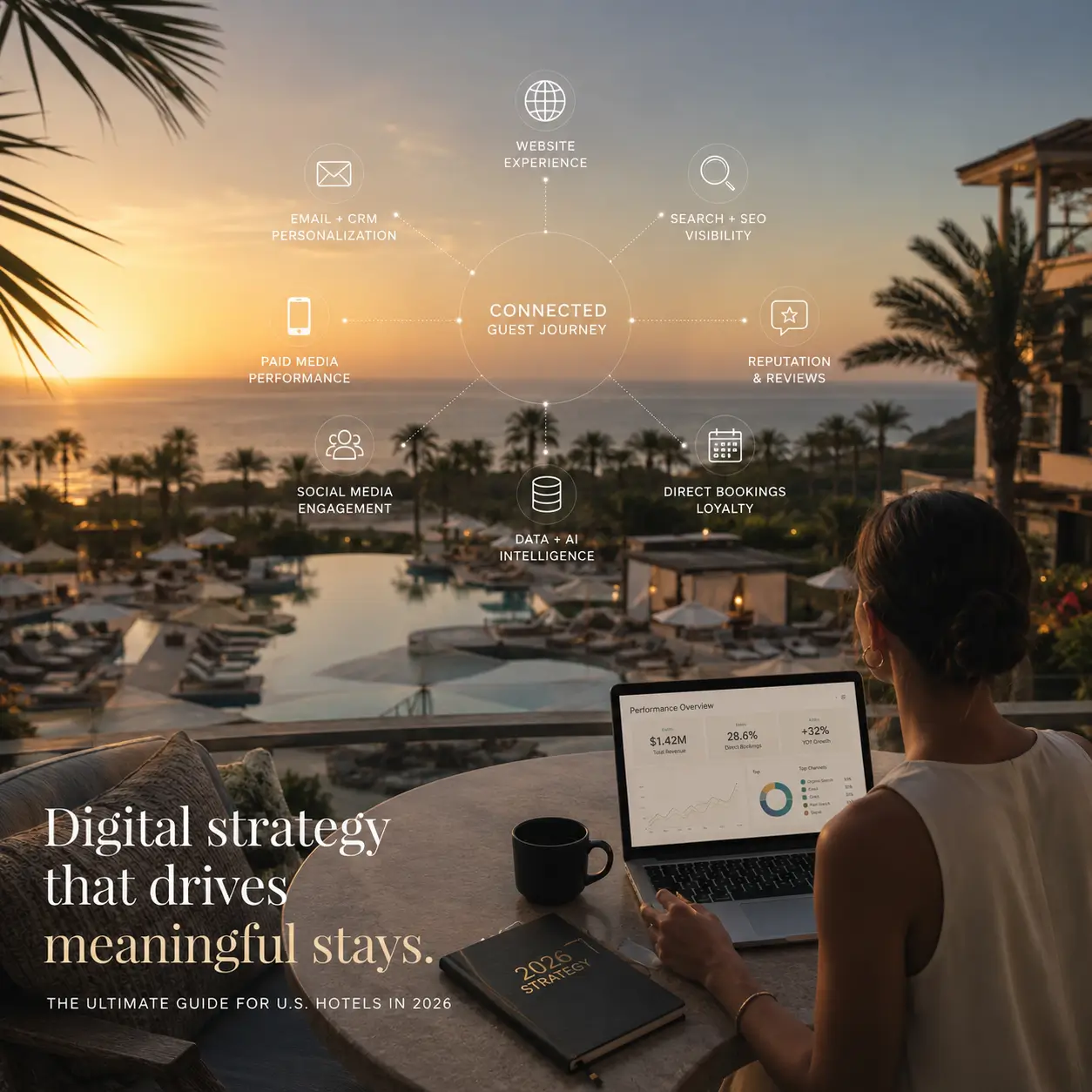
Hotel Digital Marketing: The Ultimate 2026 Guide for US Hotels
Short answer: build a unified, mobile-first, data-literate commercial engine that reduces OTA dependence and meets rising expectations for personalization and social discovery.
Online channels drive the majority of travel revenue, so direct-channel excellence, compliant data use, and AI-ready content now decide who grows in 2026.
Here’s the roadmap. We pair market data with field-tested tactics across SEO, metasearch, paid media, social, content, email, and reputation. You’ll see how to fix conversion leakage, operationalize personalization responsibly, and structure content for AI engines. We include real performance examples from Hooray Agency and cite authoritative sources throughout to help owners, operators, and marketers make confident, measurable decisions.
Key Takeaways
- Online channels generated about 70% of global travel revenue, so digital is your primary battleground for demand and margin Statista.
- OTAs (Online Travel Agencies) held a narrow lead in 2024, $266B vs $262B for hotel sites; direct can overtake if you fix friction and unify UX Skift.
- Social and personalization now shape demand: 61% booked after seeing a hotel on Instagram, and 61% would pay more for customized stays Hoopla Marketing HospitalityNet.
Why Digital Marketing is Essential for US Hotels in 2026
Digital is where demand forms and converts. Online channels generated roughly 70 percent of global travel and tourism revenue in 2024, confirming the channel shift that now defines commercial performance Statista. OTAs (Online Travel Agencies) held a thin edge that year, $266B vs $262B for hotel websites, yet direct is poised to gain share as hotels elevate digital execution Skift.
Traveler behavior amplifies this. Social discovery pushes intent upstream: 61 percent have booked a hotel after seeing it on Instagram, and 75 percent say social media influenced their destination choice Hoopla Marketing. For US operators, the opportunity is large but complex due to privacy compliance and fragmented state rules; a structured, compliant digital program is now table stakes.
Core Concepts: What is Hotel Digital Marketing?
Hotel digital marketing is the integrated use of owned, paid, and earned channels to attract, convert, and retain guests while protecting rate integrity and data trust. Guests compare options across ecosystems, with 81 percent checking at least two channels before booking, which makes orchestration across your website, metasearch, and social imperative Gourmet Marketing.
Owned media covers your website, booking engine, CRM (Customer Relationship Management), email, blog, and social profiles. Paid media spans search ads, Google Hotel Ads, metasearch, display, and paid social. Earned media includes reviews, press, influencer content, and organic shares. The job is to make these channels reinforce each other so discovery leads to direct booking without friction Amadeus Hospitality.
Building Your Hotel’s Digital Marketing Foundation
Start with positioning, not platforms. The American Hotel & Lodging Association highlights guests’ growing appetite for differentiated, experience-led stays, which means generic claims will not cut through crowded markets. Translate your value proposition into visuals, copy, and offers that are consistent across your site, metasearch, paid media, and email.
Calibrate segments by channel. TikTok matters for rising cohorts: roughly three in ten UK travelers use it for trip planning or sharing travel content, rising to about six in ten among Gen Z, a signal of where attention is moving Statista. Pair this with Instagram for upper-funnel storytelling and metasearch for lower-funnel capture.
Competitive audit checklist:
- Map your top five OTA (Online Travel Agency) and metasearch appearances vs direct. Note parity gaps and missing content.
- Benchmark your site and booking engine speed, mobile UX, and inventory clarity against two local competitors.
- Inventory social proof: recency and volume of Google and TripAdvisor reviews, plus influencer and UGC (User-Generated Content) assets.
- Identify friction from ad click to room selection to payment. Document drop-off points.
- Align KPIs to SMART goals, such as improving direct booking share or reducing cost-per-acquisition, and track weekly.
Critical Digital Marketing Channels for Hotels in 2026
SEO and content. Build destination and experience authority with structured FAQs and editorial blogs. We see blogs increase the likelihood of being directly cited in AI-generated answers about five fold, while robust FAQs win precision queries like policies and amenities. This improves findability and narrative control across answer engines.
Metasearch and paid media. Participate consistently in Google Hotel Ads and major metasearch to intercept high-intent shoppers, then reinforce with branded paid search and remarketing HospitalityNet. Treat bids, parity, and offer messaging as one system with your booking engine for minimal leakage.
Social platforms. Social converts desire into demand. 61 percent have booked a hotel after seeing it on Instagram, and social influences destination choices for a large share of travelers Hoopla Marketing. Use Instagram Reels and TikTok for short-form storytelling; the TikTok signal is strongest among Gen Z cohorts Statista.
Email and lifecycle. Monitor open rate, click rate, unsubscribes, and revenue per email to steer frequency and creative Salesforce.
One urban luxury client used Hooray’s Catalyst audiences to send 109,398 emails, with 99.3% delivered, a 41.2% open rate, 4.1% click rate, 82 reservations, and $156,999 in revenue. A Florida Gulf Coast resort drove 19 reservations and $20,144 from 57,185 sends at a 22.4% open rate.
Mobile-first experiences. Your guest journey is thumb-first. Hooray’s philosophy is simple: ‘With the ubiquity of global online usage, we must create personalized digital communications that reach, respond, and react to every point-and-click. Putting mobile first is critical.’
Content built for AI visibility
Answer engines favor content that directly answers questions, uses structured formats, and offers comparisons or lists. We combine FAQs for operational clarity with listicles, destination guides, and experience pages to help AI understand, trust, and recommend the brand. The goal is not just visibility but first-party citation, so your content becomes the source AI credits, not a third-party aggregator.
Strategies to Win More Direct Bookings
The distribution fight is close. In 2024, OTAs (Online Travel Agencies) drove about $266B in hotel gross bookings, with hotel sites at $262B, a gap that tightens as hotels improve direct execution Skift. Since 81 percent of travelers compare at least two channels, any friction in your direct path sends shoppers back to OTAs Gourmet Marketing.
Fix conversion leakage. Most hotel sites convert at less than one-third the rate of OTAs, often due to inconsistent UX or missing information. Treat the website and booking engine as a single e-commerce flow: consistent design, clear room comparisons, prominent offers, and transparent fees across every step Gourmet Marketing. Align paid media with direct-only incentives and loyalty benefits OTAs cannot match.
Close the loop. Use metasearch and branded search to capture bottom-funnel demand, then reinforce with email and CRM (Customer Relationship Management)-backed remarketing. Hooray’s Catalyst helps identify anonymous visitors and activate compliant first-party data, enabling timely, personalized nudges that lift direct bookings while reducing reliance on third parties.
Online Reputation and Review Management
Reviews and social proof drive trust at the moment of decision. In the US, 66 percent of consumers trust online reviews more than any other information source when making purchase decisions Hoopla Marketing. UGC (User-Generated Content) is viewed as 2.4 times more authentic than brand-created content, which makes curated UGC a high-ROI asset for ads and landing pages Hoopla Marketing.
Influencer integration. 92 percent of consumers trust influencer recommendations more than traditional advertising Hoopla Marketing. For urban boutique hotels, we pair TikTok and Instagram Reels creators with stay packages, then reuse short-form content in paid placements and on booking pages to compress the path to purchase.
Crisis response. Keep a simple playbook: rapid acknowledgment, facts-only updates, consistent messaging across Google Business Profiles, social, and your website, and a plan to follow through once the issue is resolved. Hotels that respond quickly and empathetically tend to contain reputational risk more effectively.
Advanced Digital Marketing Strategies for 2026
AI-powered personalization. Personalization correlates with willingness to spend: 61 percent of surveyed hotel guests would pay more for customized experiences, and 78 percent are more likely to book accommodations that offer them. Yet only 23 percent report high levels of personalization today, a clear gap to close HospitalityNet. We deploy recommendation models for rooms and add-ons, and chatbots that handle common requests while escalating to people for nuanced needs.
Data, privacy, and compliance. Hotels now operate within a complex web of US federal and state privacy and data security laws. Smart room tech and identity data increase risk, which makes governance, vendor diligence, and practical controls critical Goodwin. Our Catalyst platform is designed to enable first-party data use with compliance safeguards aligned to CCPA, GDPR, HIPAA, and NIST 800.
Voice and structured data. Markup that clarifies amenities, policies, and FAQs helps answer engines resolve operational queries. Focus on structured FAQs, accurate local listings, and consistent NAP data across platforms to improve answer readiness.
AI visibility and narrative control
AI is becoming the interface for discovery. The question is, are you being mentioned or cited? We have seen that structured FAQs win operational questions and editorial blogs drive narrative ownership across long-tail prompts. Our Momentum AiQ platform measures and improves how hotels appear in AI answers, then guides content sprints to earn first-party citations at scale.
Budgeting, Measurement, and ROI
Tie spend to business outcomes you can observe. Track website sessions, bounce rate, conversion rate, channel-level CPA, ROAS (Return on Ad Spend), revenue, RevPAR (Revenue Per Available Room) contribution, and lifetime value to judge which channels truly move the P&L Amadeus Hospitality Gourmet Marketing. For lifecycle programs, monitor open rates, click rates, unsubscribes, and revenue per email to tune cadence and creative Salesforce.
Use a simple rhythm. Review weekly operational metrics, monthly cohort performance, and quarterly attribution insights to reallocate budget directionally. When in doubt, prioritize friction removal on direct channels before expanding media reach.
Core metrics to instrument
| Metric | Where to measure | Why it matters |
|---|---|---|
| Direct booking rate | Booking engine, CRM (Customer Relationship Management) | Confirms channel shift toward margin-rich revenue |
| Conversion rate | Analytics, booking engine | Reveals leakage points to fix |
| Cost per acquisition | Ad platforms, CRM (Customer Relationship Management) | Aligns spend with profitability |
| ROAS (Return on Ad Spend) | Ad platforms | Gauges efficiency of paid media |
| Email revenue per send | ESP, CRM (Customer Relationship Management) | Validates lifecycle program impact |
| Review score trend | Google, OTAs (Online Travel Agencies) | Signals trust and service alignment |
Common Pitfalls and Mistakes to Avoid
Letting conversion leakage persist. Most hotel websites convert at less than one-third the rate of OTAs (Online Travel Agencies), which means you are paying for traffic that ends up booking elsewhere Gourmet Marketing. Fix this by unifying site and booking engine UX and eliminating fee surprises late in the flow.
Underestimating compliance risk. Smart devices and identity data increase exposure. US hotels must evaluate vendor practices and breach response plans to avoid regulatory and reputational harm Goodwin.
Over-relying on third parties. If metasearch, review sites, or influencers outrank or out-credit your content, you lose narrative control. Build owned content and distribution so AI and travelers cite you directly.
Future-Proofing Your Hotel’s Digital Marketing
Expect acceleration, not stasis. Industry analysis indicates generative AI will shape both marketing and service delivery, from guest communications to on-property experiences. Pair machine-driven recommendations with human hospitality to keep the brand’s emotional core intact HospitalityNet.
Quarterly improvement checklist:
- Refresh structured FAQs and destination content to align with seasonal demand.
- Audit parity and offer alignment across metasearch, OTAs (Online Travel Agencies), and direct.
- Re-test the mobile booking flow and reduce clicks to pay.
- Rotate creative for Instagram and TikTok based on high-performing hooks.
- Review privacy notices, data maps, and vendor DPAs (Data Processing Agreements) with legal counsel.
How Hooray partners to innovate and win
We integrate strategy, creative, media, and technology for hospitality brands. Momentum AiQ helps hotels get cited by AI, not just mentioned. Catalyst reclaims first-party data and activates compliant remarketing. Our in-house production team builds visual storytelling that converts across site, social, and paid. The result is a direct channel that is fast, personalized, and hard to ignore.
Hotel Digital Marketing FAQs 2026
Q: Why is digital marketing essential now? A: Online channels generate the majority of travel revenue, and OTAs (Online Travel Agencies) still capture a large share, so direct excellence is mission-critical Statista Skift.
Q: How do we increase direct bookings? A: Remove conversion leakage, align site and booking engine UX, and use metasearch plus CRM (Customer Relationship Management) to keep shoppers in your direct flow Gourmet Marketing.
Q: Which social platforms matter in 2026? A: Instagram drives bookings and TikTok usage is strong among Gen Z, so use Reels and short-form video for discovery and proof Hoopla Marketing Statista.
Q: Is personalization worth it? A: Yes. 61 percent would pay more for customized experiences, and 78 percent are more likely to book when stays are personalized HospitalityNet.
Get Expert Help: How Hooray Agency Drives Digital Results
We are here to make you impossible to ignore. Hooray Agency combines integrated strategy, creative, media, and proprietary platforms built for hospitality. Momentum AiQ measures and improves your AI visibility so your brand gets credited as the source. Catalyst identifies anonymous website visitors and activates compliant first-party data to lift direct bookings, with client campaigns producing strong open rates and six-figure revenue from a single send.
What you get: mobile-first site and booking UX, search and metasearch performance, social storytelling and UGC (User-Generated Content) engines, lifecycle programs, and governance embedded by design. Ready to accelerate direct revenue with a partner built for luxury and lifestyle hospitality? Book a consultation, request our competitive audit checklist, or subscribe for quarterly playbooks.
Conclusion
Direct bookings grow when your brand is easy to find, fast to trust, and effortless to book. The data is clear: social discovery and personalization shape intent, AI influences what gets recommended, and compliance underpins long-term trust. Fix conversion leakage, build AI-ready owned content, participate fully in metasearch, and operationalize first-party data with care.
If you want a partner to stitch this together end-to-end, we can help. Hooray brings integrated strategy, in-house production, Momentum AiQ for AI visibility, and Catalyst for compliant data activation. Let’s audit your current journey, prioritize quick wins, and stand up a direct engine built for 2026. Book a consultation to get started.
References
- Online travel market – statistics & facts
- Hotel Versus OTA Direct-Booking Tussle Will Shape Distribution for Years to Come
- Hotel Marketing Statistics
- TikTok use for travel purposes in the UK by generation
- AI in Hospitality: Creating Personalized Customer Experience
- Hotel Website Conversion Optimization
- The Role of Hotel Metasearch in Travel Marketing
- Email Marketing Benchmarks
- Navigating Privacy and Data Security Challenges
- Ultimate 2026 Guide To Hotel Marketing