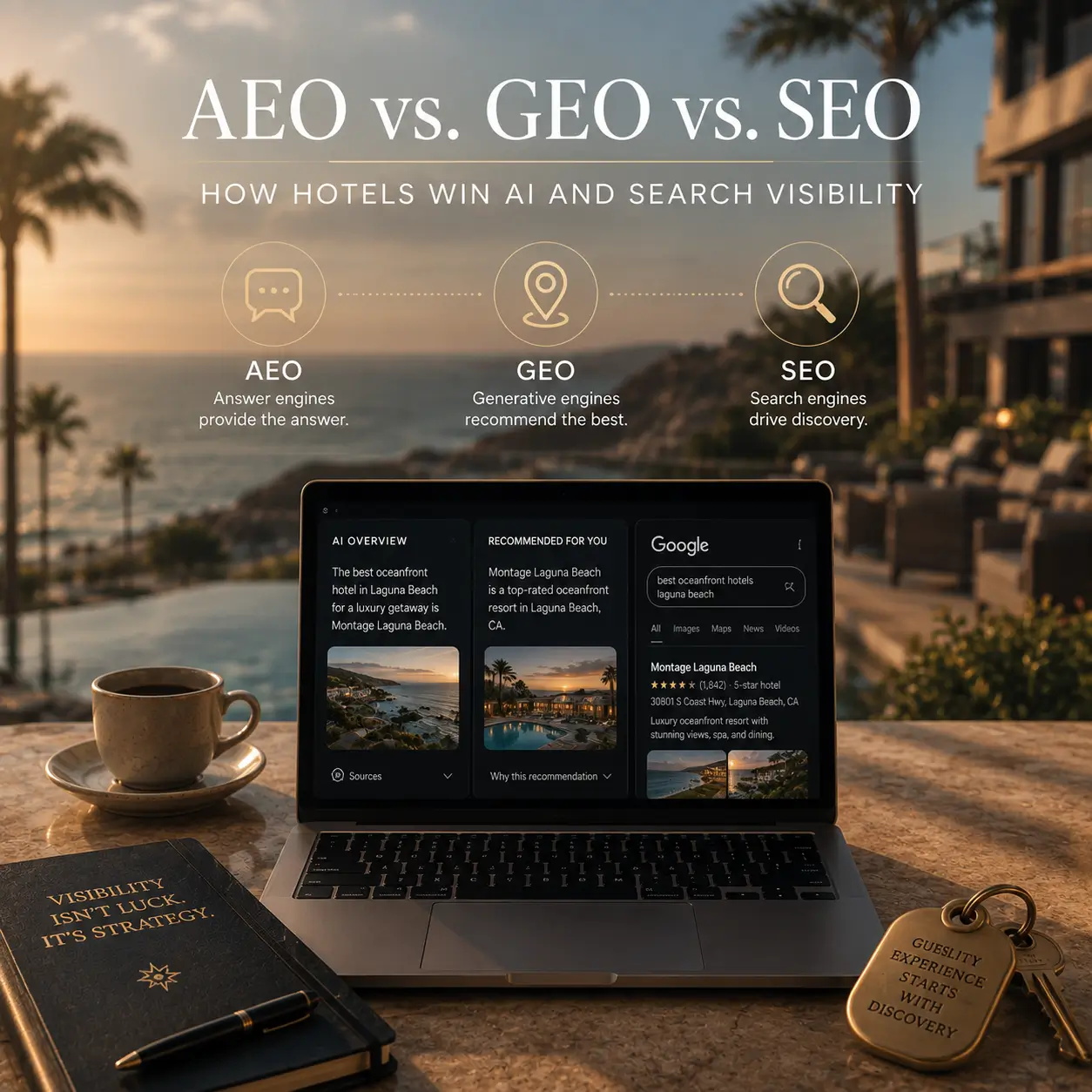
AEO vs GEO vs SEO: How Hotels Win AI and Search Visibility
Short answer: Hotels should treat AEO, GEO, and SEO as a blended system. AEO earns citations in AI answer boxes with structured FAQs.
GEO builds authority and narrative so generative engines select and credit you. SEO remains the technical and local backbone that captures high-intent clicks and supports both AEO and GEO.
Context: Search is shifting to AI selection. Zero-click behavior now dominates, with 64.82% of Google searches ending without a click, so being selected and cited matters as much as ranking (Digital Applied). Generative queries are longer and nuanced, averaging about 23 words, which favors conversational content and verifiable sources (a16z). This guide compares AEO, GEO, and SEO for hotels, shows where each excels, and outlines how to layer them to earn visibility, citations, and revenue.
Key Takeaways
- Zero-click is real: 64.82% of Google searches end without a click, so selection and citation now drive value (Digital Applied).
- Generative queries are longer and intent-rich, averaging ~23 words, which rewards conversational, verifiable content (a16z).
- Local still matters: Google's Map Pack captures roughly 42% of local clicks for hotels and similar businesses (Hooray Agency).
What is the difference between AEO, GEO, and SEO for hotels?
Think in terms of where and how selection happens. SEO optimizes for classic blue links by aligning keywords, content depth, technical quality, and off-site signals. It captures branded and transactional demand on engines like Google and Bing (O'Rourke Hospitality). AEO prepares your facts for instant answers. It structures data and FAQs so answer engines and AI Overviews can extract precise, citation-ready responses without a click (InsideHS). GEO adapts your narrative and proof signals for generative engines that synthesize multi-source replies, favoring semantically rich content and credible citations over keyword repetition (a16z; Eighty Days).
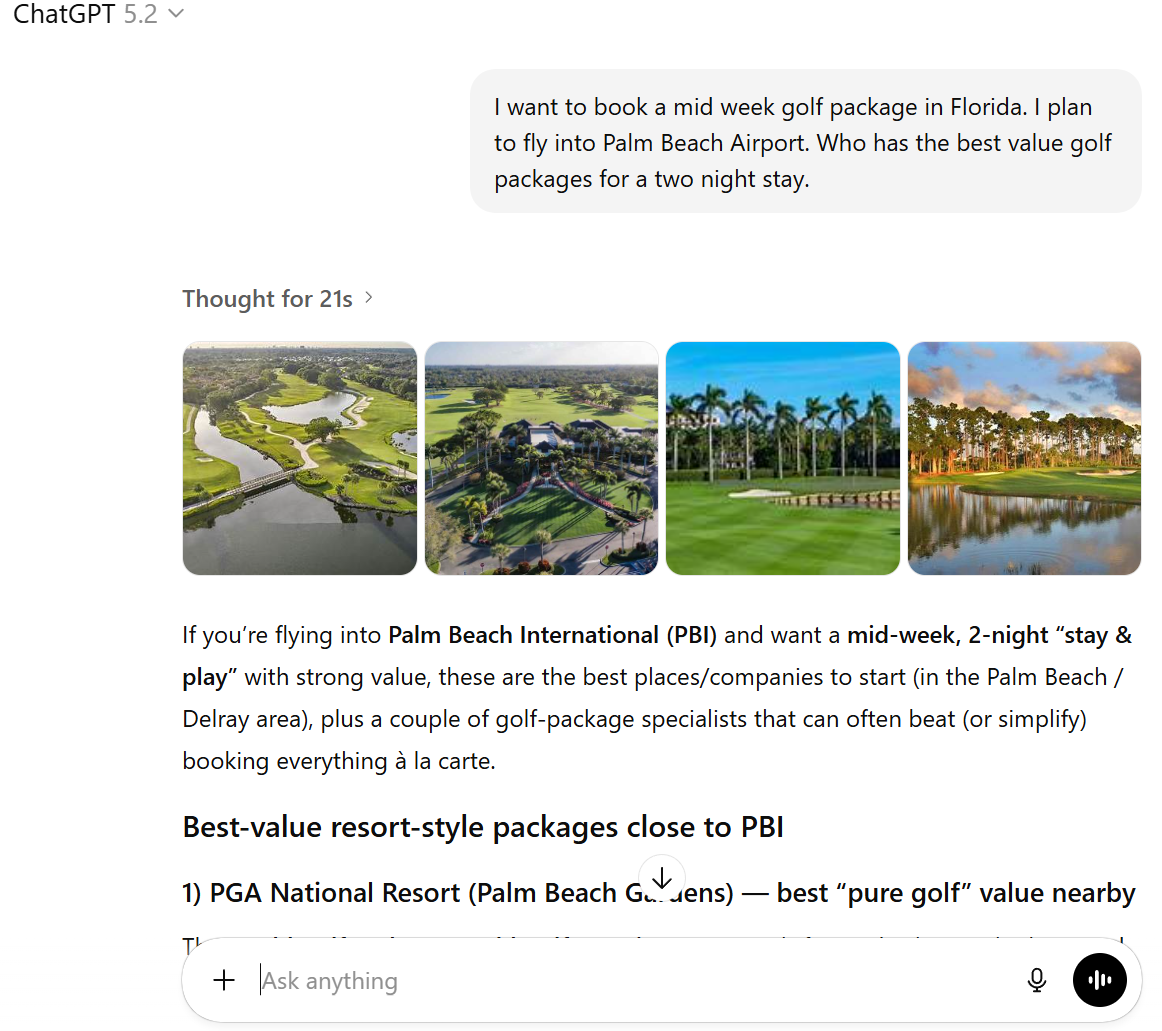
Two queries, two worlds: "Miami beach hotel" suits SEO. "Which boutique hotels in New Orleans have live jazz on weekends and are within walking distance of the French Quarter?" suits AEO and GEO, since answer engines must parse specifics and justify picks across sources.
Side‑by‑side at a glance
| Strategy | Primary goal | Best for queries | Core formats | Anchor stat |
|---|---|---|---|---|
| AEO | Be cited in AI answers | Factual, policy, logistics | FAQs, structured data | AI shortlists under 5 options (HospitalityNet) |
| GEO | Be selected in generative summaries | Long, conversational prompts | Blogs, guides, comparison pages | GenAI queries avg ~23 words (a16z) |
| SEO | Rank in blue links and maps | Branded, local, transactional | Technical SEO, on-page, GBP | Map Pack ~42% of local clicks (Hooray Agency) |
How does AEO impact hotel search visibility?
Answer engines compress choices. AI systems often cap hotel recommendations at fewer than five options, which turns visibility into selection and citation, not just ranking (HospitalityNet). AEO improves your odds by giving AI precise, verifiable snippets. Structure FAQs around policies and amenities, keep data consistent across your site, Google Business Profile, and review platforms, and use schema to make extraction simple (InsideHS).
We see answer engines actively extract section-level content like FAQ entries on pet policies or parking over long pages relying on keyword density. In AI Overviews, complex prompts get decomposed. For example, "What are the best eco-friendly hotels in Austin with free parking?" is split into sustainability criteria, location, parking, and reviews. Clear, unambiguous answers win these micro-decisions.
As AI Overviews reduce organic CTR by an average of 18 percent, the clicks that remain convert 23 percent better, so owning the extracted answer and the click matters more (Digital Applied).
Our client work confirms the pattern. Properties with strong FAQ systems dominate operational queries like pets, parking, and fees. FAQs are one of the most reliable ways to become the cited source for these topics.
How does GEO differ and why is it important for hotels?
GEO aligns your brand story and proof with how generative engines reason. Generative prompts are longer, averaging about 23 words, which means AI agents look for context, narrative, and cross-source validation, not just exact matches (a16z). GEO leans on semantically dense content, destination context, comparisons, and citations from credible sites and UGC.
Think listicles for discovery, comparison pages for decision support, and destination guides for authority. These formats match how answer engines synthesize recommendations and how travelers ask multi-part questions (Eighty Days).
We have repeatedly seen blogs expand AI visibility across conversational queries and increase direct AI citations fivefold, because they supply narrative plus verifiable details. In recent analysis, properties leveraging narrative blogs achieved strong visibility in LLM responses, including Condado Vanderbilt at 79.6 percent and La Concha at 44.4 percent. Robust FAQ programs also contributed, with Innisbrook at 46.7 percent and Black Desert at 30.7 percent. These examples show that discovery and operational depth both matter. GEO does the former at scale, while AEO secures factual precision.
What GEO requires in practice
- Treat metadata, headings, and internal links as signals to help models summarize you accurately.
- Maintain consistent facts across your site and profiles.
- Monitor where AI tools cite you, then reinforce the content or references they use most.
- Pair destination storytelling with concrete proof points like awards, sustainability standards, and review consensus so engines can verify claims.
When should hotels prioritize traditional SEO?
SEO is still the backbone. It ensures your site is crawlable, fast, mobile-friendly, and structured, which supports AEO and GEO. It also captures branded and transactional demand, and drives critical local visibility. Google's Map Pack captures roughly 42 percent of local clicks, so well-optimized Google Business Profiles and local content remain high ROI for hotels (Hooray Agency).
AI Overviews now sit above classic results and depress organic CTR by about 18 percent. The upside is that the clicks that survive convert 23 percent better than before, which means technical SEO that preserves and prioritizes those journeys pays off (Digital Applied). Focus on tasks that compound: site speed, structured data, content architecture, and branded dominance so your direct site outperforms OTAs for your name plus location searches (O'Rourke Hospitality).
Combined Strategies: How should hotels balance AEO, GEO, and SEO?
Layer the strategies to cover all touchpoints. Use SEO to harden technical foundations and win maps, branded, and transactional demand. Use AEO to win selection in compressed AI shortlists with precise, structured answers. Use GEO to earn narrative inclusion and citations across long, conversational prompts. With 64.82 percent of searches ending without a click, funding AEO and GEO alongside SEO is now a budget necessity, not a nice-to-have (Digital Applied; InsideHS).
A practical cadence works best: audit site structure and schema, build a definitive FAQ hub tied to GBP attributes, then publish destination and comparison content that answers how travelers actually ask. Hospitality budgets that blend website development, technical SEO, and AI-focused content investments see the most resilient results over time (O'Rourke Hospitality; Writer.com).
A simple allocation playbook
- Foundation: fund crawlability fixes, speed, mobile UX, and structured data.
- Precision: ship a searchable FAQ system that covers policies, fees, and logistics, mapped to GBP.
- Discovery: publish destination, experience, and comparison content that can be cited by AI and shared by partners.
- Feedback loop: track where AI cites you and reinforce those pages with clearer structure and proofs.
How does Hooray Agency approach AEO, GEO, and SEO for hotels?
We build for selection, not just ranking. Our model pairs structured FAQs for precision and citation with editorial blogs for discovery and narrative control, then reinforces both with technical SEO and external authority. We analyze about 200 real AI search prompts per property using Momentum AiQ to simulate traveler behavior and tune content to win first-party citations and reduce reliance on third parties.
Results we have seen: blogs increased the likelihood of being directly cited fivefold in AI-generated answers. In visibility analyses, narrative-led properties like Condado Vanderbilt reached 79.6 percent visibility in LLM responses, while robust FAQ programs such as Innisbrook reached 46.7 percent. The principle is simple: "Visibility gets you mentioned. Owned content gets you credited and tells your story the way you want." Our approach keeps brands adaptable as models, AI Overviews, and traveler behaviors evolve.
Our operating lens
"The question is no longer: 'How do we rank?' The real question is: 'What type of content gives AI the confidence to cite us?'" We align formats to intent: FAQs for direct answers, blogs and guides for discovery, comparisons for decision support, and authority signals for trust.
FAQs: AEO, GEO, and SEO for Hotel Marketing
Q: Can AEO replace traditional SEO for hotels? A: No. AEO is critical for AI answer boxes and zero-click behavior, but SEO remains foundational for transactional demand and local discoverability, including Google's Map Pack that captures roughly 42 percent of local clicks (Hooray Agency; InsideHS).
Q: Will GEO become the dominant optimization strategy? A: GEO is rising as queries become longer and more conversational, but it will not stand alone. Visibility is a layered contest shaped by AI agents and ongoing model updates. GEO depends on AEO's structured facts and SEO's technical backbone to make your content parseable, verifiable, and discoverable (a16z; Digital Applied).
Structured Data: Article and FAQ schema
Article schema
FAQPage schema
Conclusion
AI has shifted hotel visibility from ranking to selection. AEO wins precise citations in compressed answer boxes. GEO earns inclusion and credit in long, conversational summaries. SEO remains the technical and local engine that preserves high-intent demand and amplifies both. With zero-click behavior at 64.82 percent, and AI Overviews reshaping CTR and conversion, layering these disciplines is now core strategy, not experimentation (Digital Applied).
Next steps: audit your technical SEO and GBP, build a definitive FAQ hub, publish destination and comparison content that models can cite, and track AI citations to refine. If you want a partner that builds for selection and ownership, we can help align AEO, GEO, and SEO so your brand gets mentioned, credited, and booked.
References
- Zero-Click Search Statistics 2026: Complete Data
- GEO over SEO
- Hotels Can Win Visibility with Agent Engine Optimization (AEO)
- Local SEO for Luxury Hotels
- Time to Pivot to Answer Engine Optimization (AEO)?
- GEO and the Future of Hotel Search
- 4 Key Hotel Website SEO Factors Impacting Organic Bookings
- How Hotels Can Win in the AI-Powered Discovery Era
- GEO and AEO Optimization
- Crafting an Effective Hotel Marketing Budget