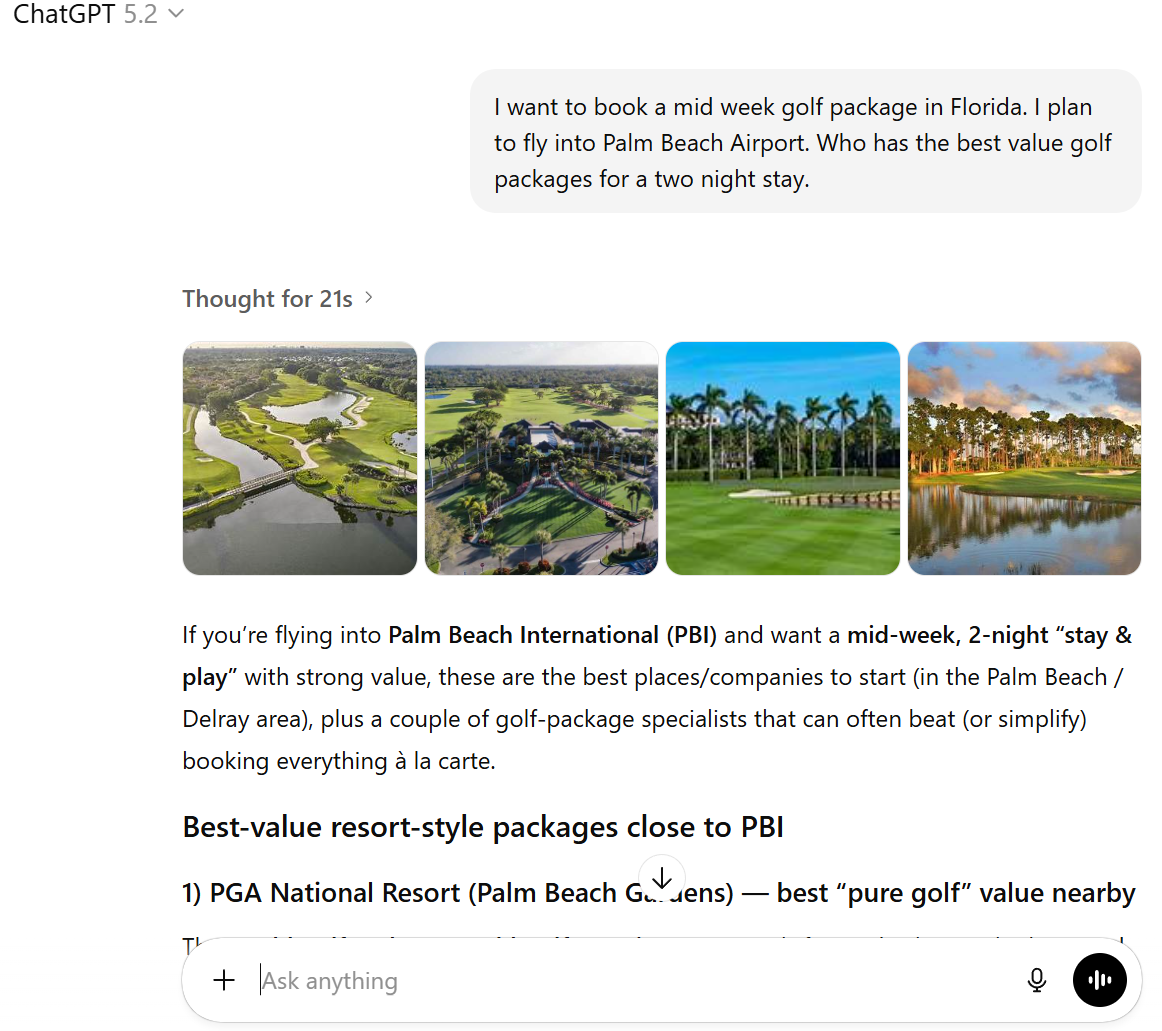

What We Learned After Analyzing AI Booking Revenue Across Multiple Hotels
As AI-powered travel discovery rapidly changes how travelers research and book hotels, many hospitality marketers are asking the same question:
What actually influences AI-driven booking revenue?
To better understand the relationship between AI visibility and direct revenue performance, Hooray Agency analyzed AI traffic, citation, visibility, and revenue data across a portfolio of luxury, resort, urban, and destination hotel properties in the United States.
While the dataset is still early-stage and evolving, several clear patterns emerged.
The Strongest Predictor Was Not …….
One of the most surprising findings from the analysis was that overall AI “visibility” alone was only moderately correlated with booking revenue.
Properties with high AI visibility did not always generate strong revenue performance.
Instead, the strongest predictor of AI-driven revenue was these two factors:
1. Qualified AI Session Volume
Hotels receiving larger volumes of AI-origin traffic consistently generated more booking revenue. In our analysis, the correlation between AI sessions and AI-attributed revenue was significantly stronger than citation count or visibility score alone.
This suggests that simply being mentioned by AI platforms is not enough. What matters is whether those mentions drive travelers into high-intent booking journeys.
2. Revenue Per AI Session Revealed the Real Winners
Another key finding emerged when we evaluated revenue efficiency rather than raw traffic volume.
Several properties generated substantially more revenue per AI session than others, despite having lower overall traffic.
The strongest-performing hotels shared several common characteristics:
- Luxury or upscale positioning
- Strong destination appeal
- Clear experiential value
- High-intent leisure demand
- Distinctive property identity
Examples included:
- Iconic downtown luxury hotels
- Oceanfront resorts
- Golf and wellness destinations
- Walkable urban leisure properties
These hotels appear particularly well aligned with the way travelers currently use AI search tools.
AI Discovery Appears to Favor Intent-Based Travel Planning
Unlike traditional search behavior, AI travel discovery is often conversational and recommendation-driven.
Travelers are increasingly asking questions such as:
- “Best luxury hotel in Charleston”
- “Oceanfront resorts in Puerto Rico”
- “Best golf resort for a couples getaway”
- “Boutique hotels near Monterey attractions”
Properties with strong experiential positioning and destination relevance appear more likely to convert these AI-driven discovery moments into bookings.
Citation Volume Alone Was Not a Revenue Indicator
Another notable finding was that citation counts by themselves showed little direct relationship to revenue performance.
This does not mean citations are unimportant. Rather, it suggests that:
- Not all AI mentions carry equal value
- Placement within recommendation context matters
- Conversion experience still plays a critical role
In other words:
AI visibility may create awareness, but conversion quality determines revenue.
What Hotel Marketers Should Focus on Now
Based on the findings, hotel marketers should prioritize:
- AI-Friendly Content Strategy
Content should answer experiential and intent-driven traveler questions, not just target keywords.
- Distinctive Positioning
Hotels with clearly differentiated identities appear to perform better in AI recommendation environments.
- Conversion Optimization
AI traffic is only valuable if booking paths, offers, and landing experiences convert efficiently.
- Destination Authority
Hotels strongly associated with recognizable destinations or experiences may have an advantage in conversational AI discovery.
The Industry Is Still Early
AI-driven travel discovery remains in its early stages, and attribution models are still evolving. However, one conclusion is already becoming clear:
The hotels winning in AI search are not necessarily the ones with the most visibility — they are the ones best aligned with traveler intent.
As AI platforms continue to reshape the traveler journey, hospitality brands that combine strong positioning, discoverability, and conversion strategy will likely capture disproportionate revenue growth.
For hotel marketers, the opportunity is no longer theoretical. It is already measurable.
About Hooray Agency
At Hooray Agency, we help luxury hotels and resorts strengthen their presence across every guest touchpoint, including AI search, organic SEO, paid media, social media, content strategy, email marketing, analytics, and conversion optimization. Our team combines hospitality expertise with performance-driven marketing to help properties attract high-intent travelers, increase direct revenue, and build lasting guest relationships in an increasingly AI-driven world.